
July 6, 2026 · Venture Pool Company
Saltwater Pool Systems: The Complete Owner's Guide
How a salt system actually works, what it really costs over its life, the maintenance nobody mentions at the sales counter, and how I'd spec one — from a builder who installs them every month.
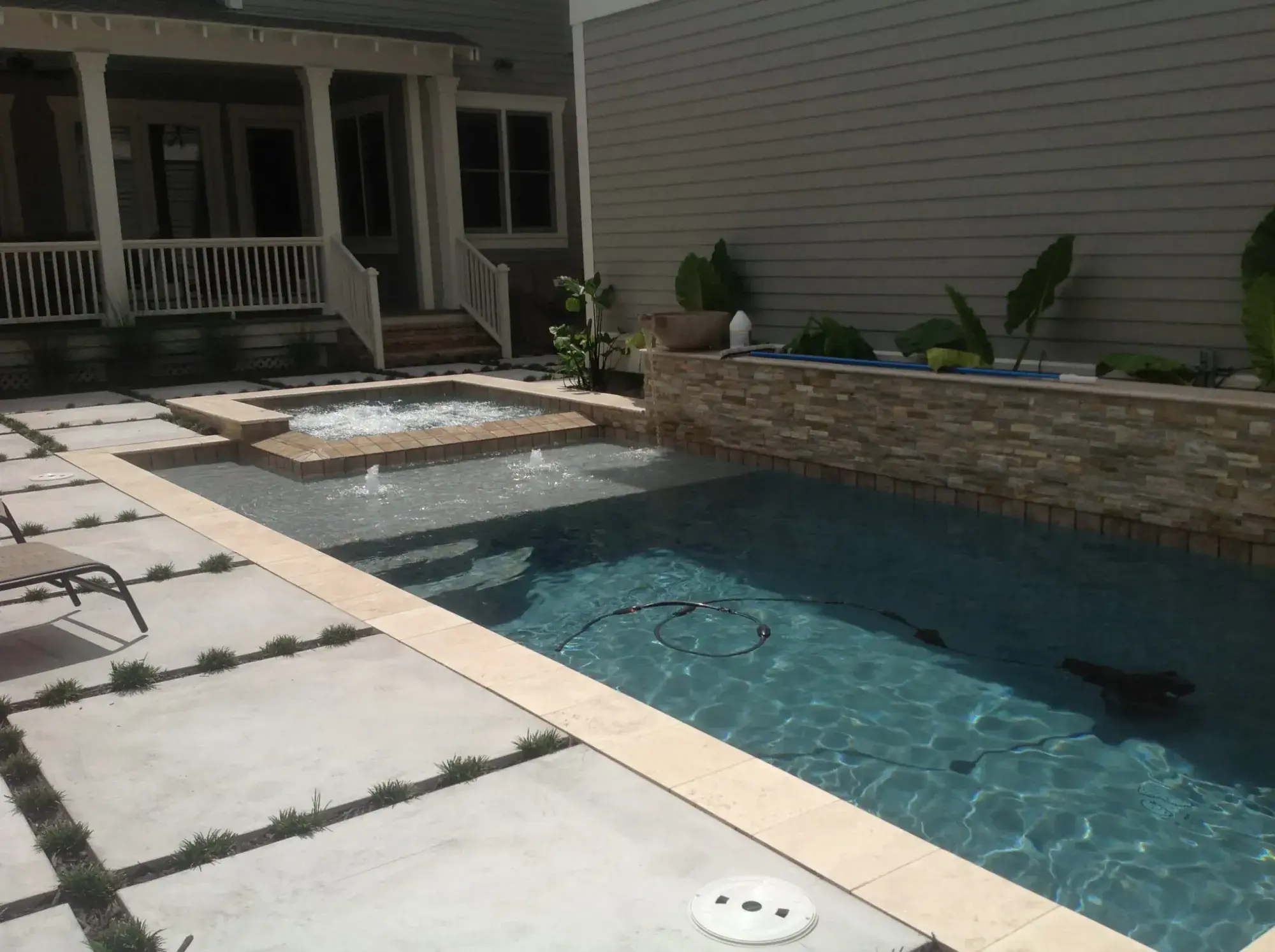
I covered the saltwater-versus-chlorine decision in another post — short version: salt pools ARE chlorine pools, and both can be great. This one is for the owner who's chosen salt, or is about to: how the system actually works, what it costs over its life, and how to run one so it lasts. This is the conversation I have at the equipment pad after every salt install.
How it actually works
A salt system has two parts on your pad: a control board and a salt cell plumbed into the return line. You dissolve a few hundred pounds of pool-grade salt into the water — target roughly 3,200–3,600 ppm, about a tenth of seawater — and as water flows through the cell, electrolysis converts that dissolved salt into chlorine. The chlorine sanitizes, then reverts back to salt, and the loop repeats.
Two things follow from that loop that every owner should internalize:
- The salt stays. You're not consuming salt like you consume chlorine jugs — you only replace what leaves via splash-out, backwash, and rain overflow. A few bags a year, usually.
- No flow, no chlorine. The cell only makes chlorine while the pump runs. Your pump runtime IS your chlorination schedule — another quiet argument for a variable-speed pump running long, slow hours.
The real cost of ownership
Sales counters quote the box price. Here's the honest ledger:
- Install: roughly $1,500–$2,500 for a quality system installed on an existing pool, depending on cell size and your pad.
- The cell is a consumable. This is the number that matters: cells last 3–7 years and replacements run $500–$1,100. Amortize that into your mental math — it's the true price of not hauling chlorine.
- Salt itself: nearly free. Call it $50–$100 a year.
- Electricity: modest — the cell draws a little while the pump runs.
Against that, you're not buying weekly chlorine, and in Houston-summer terms that's a real number too. Over a decade the costs land closer together than either camp admits; you're mostly paying for steadier chlorination and better-feeling water.
How I'd spec one (opinions, earned)
Oversize the cell. This is my number-one rule. A cell rated for 40,000 gallons on a 20,000-gallon pool loafs at 40–50% output and lasts toward the long end of its life. A "correctly" sized cell spends July at 100% output, cooking itself. The bigger cell costs a few hundred dollars more once and pays it back in cell lifespan alone.
Pick a system with a flow switch and cell-cleaning polarity reversal. Basically every good modern unit has both — the flow switch is a safety, and the self-reversing polarity keeps calcium from plating onto the cell. In Houston's hard water, that self-cleaning feature is doing real work.
The maintenance that's left (salt is low-maintenance, not no-maintenance)
- pH management is the standing chore. Salt systems naturally drive pH up, week after week. Left alone, the pH climbs, the generated chlorine gets less effective, and the owner blames the cell. Keep muriatic acid in the routine — or keep the pool on a weekly service route where it's handled.
- Inspect the cell a few times a year. Look through it; if you see white calcium scale bridging the plates despite the self-cleaning, it gets a brief acid bath. If you're doing that often, your pH/calcium balance needs attention — the scale is a symptom.
- Watch stabilizer here too. Salt pools still need CYA around 60–80 ppm (salt systems like it a bit higher than traditional pools) so the sun doesn't burn off the chlorine as fast as the cell makes it.
- Winter note: cells cut output in cold water by design — below about 60 degrees they barely produce. That's fine; cold water barely needs chlorine. Don't chase winter chlorine by cranking the cell to 100% — supplement with a little liquid chlorine on the rare cold-week it needs it.
- One cheap upgrade: a sacrificial zinc anode on the equipment pad. It takes the corrosion so your heater and metal fittings don't. Twenty-something dollars of insurance I put on every salt install.
Retrofits: what converting looks like
Converting an existing Houston pool is a half-day job on a healthy pad: plumb in the cell, mount and wire the board, add salt, verify chemistry. The one honest caveat: if your equipment is already tired — an old pump, a heater on its last legs — it's worth deciding the whole pad's future at once rather than bolting new tech onto old iron. That's exactly the kind of straight assessment we do on an equipment consultation.
Thinking about going salt, or fighting with a system you've already got? Call 713.462.0762 or request a free quote — we install, service, and troubleshoot these every week, and we'll tell you the truth about whether yours needs a fix, a cell, or just an acid routine.
Frequently asked questions
Most systems want salinity around 3,200–3,600 ppm — about a tenth as salty as the ocean. A typical Houston pool takes several hundred pounds of salt at startup, then only occasional top-offs, since salt doesn't evaporate; you mostly lose it to splash-out, backwashing, and rain overflow.
Realistically 3–7 years. Runtime, water balance, and cell sizing decide which end of that range you get. An oversized cell running at partial output lasts years longer than an undersized one running flat-out — which is why I always spec the bigger cell.
It's built into the chemistry — the chlorine-generating process naturally pushes pH upward. Every salt pool needs regular pH management with muriatic acid. It's not a defect in your system; it's the one ongoing chore salt doesn't remove.
Ready to talk about your pool?
Tell us what you need and we'll get back to you fast — usually the same day.
Keep reading
- How Much Does Pool Cleaning Cost in Houston? Here Are Our Actual Prices
Most pool companies make you call for a price. Here's exactly what weekly pool cleaning costs in Houston — our real plans, our real rates, and what moves the number up or down.
- What Pool Resurfacing Really Costs in Houston (From a Guy Who Writes the Quotes)
Real numbers, what actually drives them up or down, and how to read a resurfacing quote so you never get surprised. The pricing conversation I have at kitchen tables, written down.
- Pool Deck Resurfacing in Houston: Your Options, Honest Costs, and What Holds Up
Cracked, spalling, or just dated — the deck ages faster than the pool in Houston. Here's the full options ladder from reseal to travertine, with real per-square-foot numbers and what our clay soil does to each choice.