
July 10, 2026 · Venture Pool Company
Pool Deck Resurfacing in Houston: Your Options, Honest Costs, and What Holds Up
Cracked, spalling, or just dated — the deck ages faster than the pool in Houston. Here's the full options ladder from reseal to travertine, with real per-square-foot numbers and what our clay soil does to each choice.
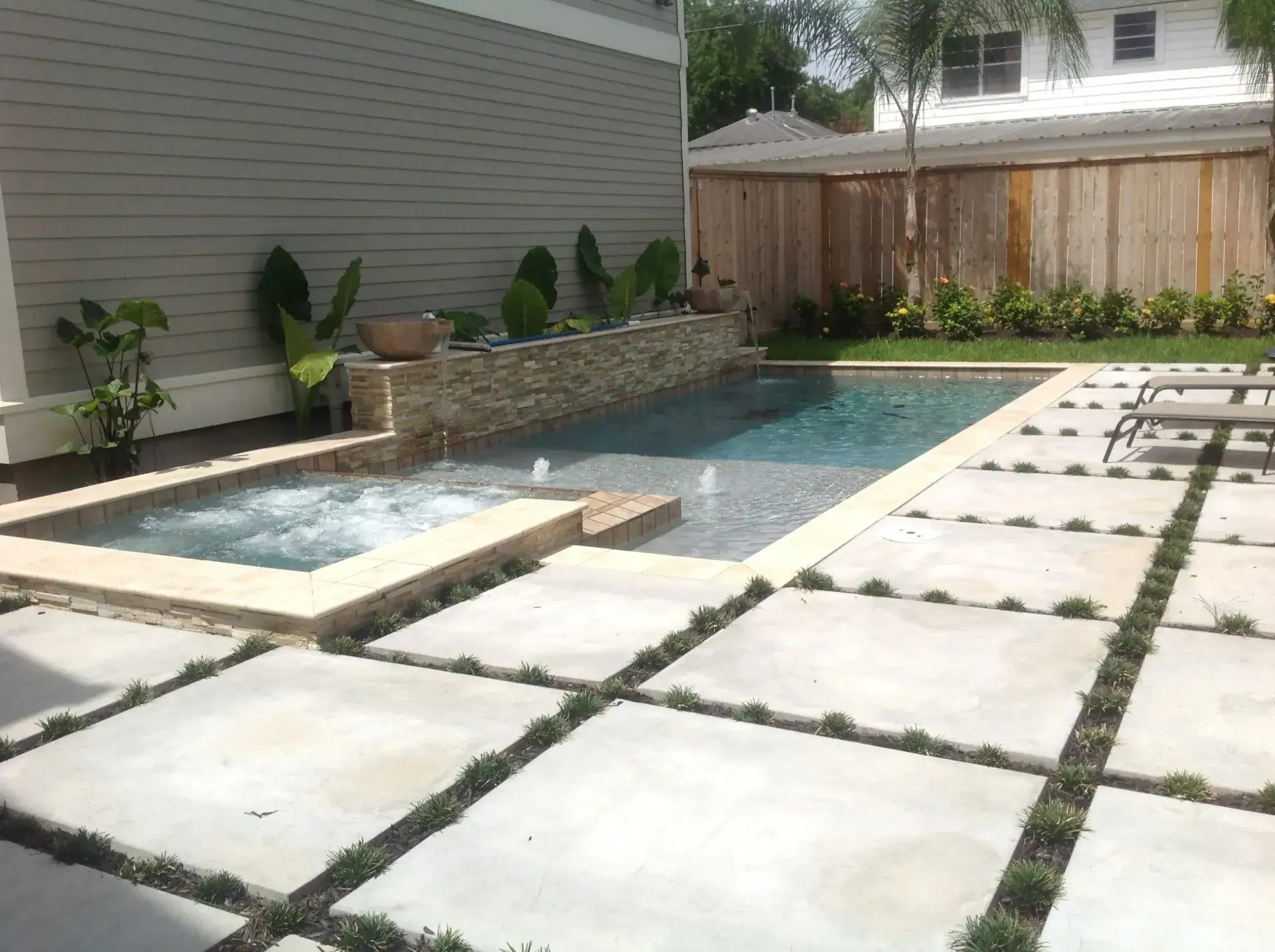
Here's a pattern I see constantly: a family renovates the pool, the water looks brand new — and now the cracked, chalky deck around it looks twice as bad by comparison. The deck ages faster than the pool in Houston, because it's the part that takes the sun, the rain, and our clay soil's mood swings all at once. So let's talk about the whole deck-resurfacing ladder, from cheapest to best, with the numbers I'd actually quote you.
First: resurface or replace? The crack test
Walk your deck and look at the cracks, because they tell you which conversation to have:
Static cracks — hairlines, surface spalling (flaking), worn or chalky texture — are cosmetic aging. The slab underneath is fine. That's overlay territory, and it's the affordable path.
Moving cracks — gaps that widen year over year, sections that have settled so one side sits higher than the other, cracks that reopen through every patch — are structural, and around here that's almost always our expanding-and-shrinking clay soil doing the moving. No overlay survives on a moving slab; it just cracks in the same places. Those sections need replacement, done with proper base prep and control joints that give the soil somewhere to flex.
Most Houston decks are a mix: stable field, one or two misbehaving sections. The smart job overlays the good and replaces the bad — which is exactly why the quote should be itemized by area.
The options ladder, with real numbers
1. Pressure wash and reseal — washing starts around $350; sealing runs $1–$3/sq ft depending on the material. Not resurfacing, but honesty demands it be on the list: if your deck is structurally fine and just dingy, a professional clean and fresh sealer buys years for hundreds, not thousands.
2. Spray texture / cool-deck style coating — starts around $4/sq ft, plus any prep. A polymer-modified coating over the existing slab: fresh uniform surface, real slip texture, and noticeably cooler underfoot — the "cool deck" name is earned. The value pick for a sound slab. On a typical 800-square-foot deck, that's a starting point around $3,200 before prep work.
3. Stamped or decorative overlay — starts around $8.50/sq ft, plus any prep. Same overlay principle, dressed up: stone and tile patterns, color layering, borders. Looks far more expensive than it is. Two cautions from experience: insist on aggressive slip texture (smooth stamped surface + pool water = skating rink), and go light on color — dark stamped concrete in August will brand your bare feet.
4. Full replacement with pavers. Demo the old slab, proper base, new pavers. The Houston-specific superpower: when the clay shifts (it will), individual pavers can be lifted and re-leveled — a repair, not a redo. The deck in this post's cover photo shows how clean the large-format look gets.
5. Full replacement with travertine. The premium standard, and around pools it earns every dollar: stays walkable-cool in full sun, doesn't slick up wet, and ages the way stone ages — gracefully. This is what we put on most of our high-end renovations and outdoor living builds.
Why no hard numbers on 4 and 5: replacement pricing lives and dies on what's under your current deck. Breaking out old concrete, hauling it, and correcting deficiencies in the subdeck or subsurface can swing the cost widely from one backyard to the next — which is why we quote replacements only after looking at the subdeck, and why any contractor who gives you a firm per-foot replacement price over the phone is guessing with your money.
The Houston factors that decide how long it lasts
- Clay soil movement is the whole game. Replacement work lives or dies on base preparation and control joints; overlay work lives or dies on choosing a slab that's actually stable. A bidder who doesn't talk about the soil isn't bidding the real job.
- Drainage. The deck must slope away from the pool and the house, and water needs somewhere to go. Resurfacing is the moment to fix a deck that puddles or sheets rainwater into the skimmer — restoring proper slope costs little during the job and a lot after it.
- Heat. Surface temperature is a real design constraint here, not a nice-to-have. Travertine and cool-deck textures pass the August barefoot test; dark stamped surfaces fail it every time.
- The coping seam. Where deck meets pool coping there's a flexible mastic joint that keeps deck movement from transferring into the pool structure. It's a small line item that protects a big asset — make sure it's on the quote.
Do it with the pool, not after
If a pool resurface is anywhere on your horizon, sequence the deck with it — demo and heavy work happen while the pool's already a construction zone, the coping ties in cleanly, and you mobilize crews once instead of twice. The pool-plus-deck combo is most of our renovation work for exactly that reason: one project, one schedule, and the whole backyard comes back at once.
Want real numbers for your square footage? Call 713.462.0762 or request a free quote — we'll walk the deck, tell you which sections can be overlaid and which are moving, and price it line by line.
Frequently asked questions
In Houston, spray-texture deck coatings start around $4 per square foot plus any prep work, and stamped or decorative overlays start around $8.50 per square foot plus prep. Full replacement with pavers or travertine has to be priced after inspecting the subdeck — demo and subsurface corrections swing those numbers widely. As a reference point, a typical 800-square-foot deck starts around $3,200 for spray texture, before prep.
Hairline surface cracks and spalling are perfect overlay candidates. But cracks that keep moving — widening, offsetting in height, re-cracking through patches — are Houston's clay soil talking, and an overlay will crack right along with the slab. Moving cracks usually mean replacing the affected sections.
Travertine is the champion — it stays remarkably walkable in full August sun. Cool-deck style textured overlays are the budget answer and genuinely work. Dark-colored anything (stamped concrete especially) is the mistake people regret by their first summer.
Ready to talk about your pool?
Tell us what you need and we'll get back to you fast — usually the same day.
Keep reading
- How Much Does Pool Cleaning Cost in Houston? Here Are Our Actual Prices
Most pool companies make you call for a price. Here's exactly what weekly pool cleaning costs in Houston — our real plans, our real rates, and what moves the number up or down.
- What Pool Resurfacing Really Costs in Houston (From a Guy Who Writes the Quotes)
Real numbers, what actually drives them up or down, and how to read a resurfacing quote so you never get surprised. The pricing conversation I have at kitchen tables, written down.
- Winterizing a Pool in Texas: Don't Close It — Protect It
Texas pools don't get 'closed' like northern pools — they run all winter. What you actually need is a freeze plan. Here's mine, learned the hard way through every Houston freeze since 2003.