
July 6, 2026 · Venture Pool Company
Resurfacing vs. Replastering: What Houston Pool Owners Actually Need to Know
Resurfacing, replastering, remodeling — the industry uses these words loosely, and homeowners pay for the confusion. Here's what each one actually means, what it costs in Houston, and which one your pool probably needs.
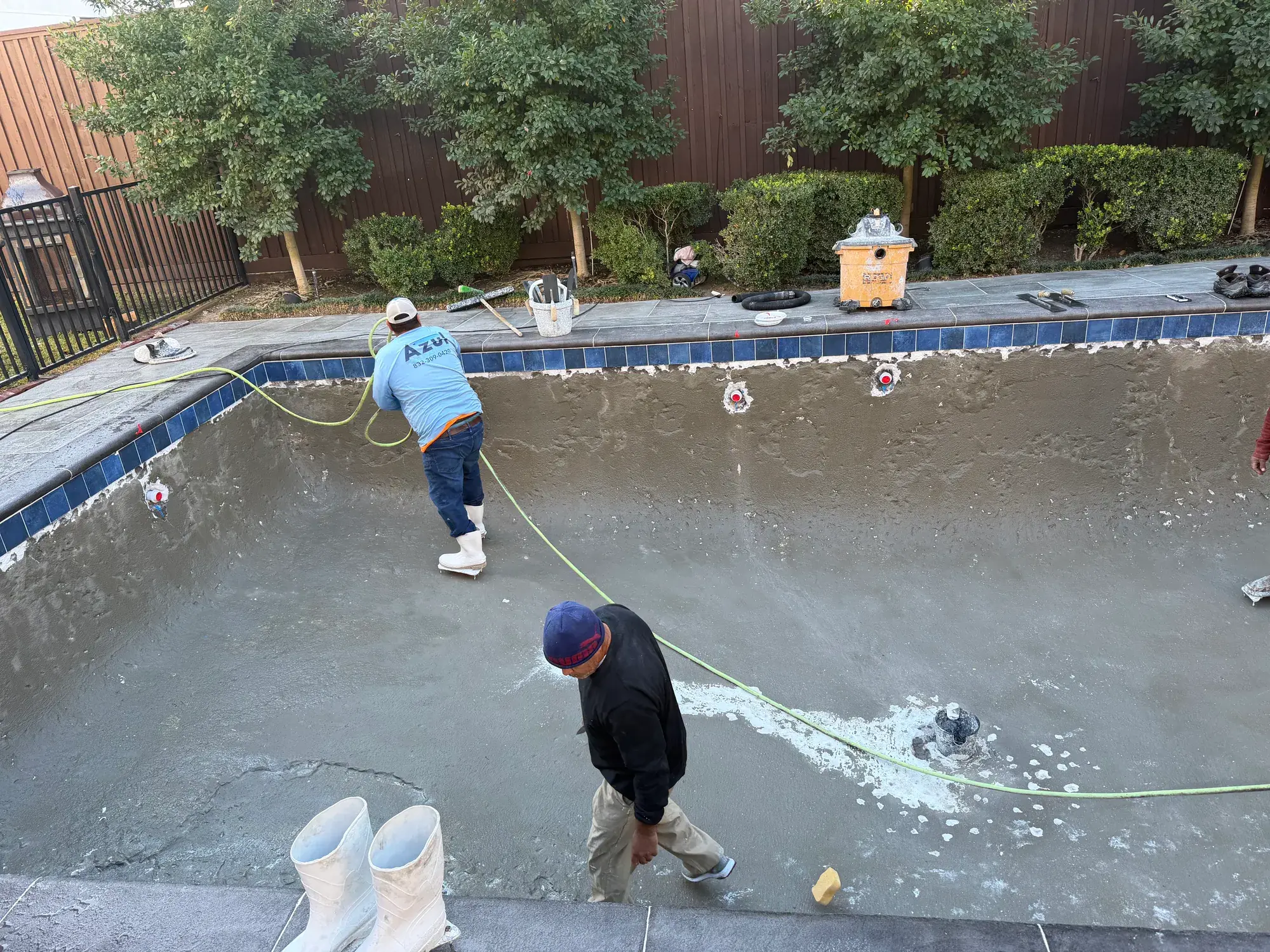
The pool industry has a vocabulary problem, and homeowners pay for it. "Resurfacing," "replastering," "remodeling," "refinishing" — I've heard all four used to describe the same job, and I've also seen quotes where the words were used differently on purpose to make comparisons hard. So let me untangle it the way I do at kitchen tables.
The words, sorted
Resurfacing is the umbrella: replacing your pool's interior finish — whatever the material.
Replastering is resurfacing where the new material is plaster. All replastering is resurfacing; not all resurfacing is plaster.
Remodeling is the bigger project: resurfacing plus tile, coping, decking, equipment — whatever combination your pool needs.
The actual work is the same skeleton regardless: drain the pool, chip out or prep the old surface, repair any shell issues, then apply the new interior and refill. What changes your outcome — and your price — is the material you choose.
The material decision (this is the real question)
Standard white plaster is the traditional choice and the cheapest — roughly $4,500–$6,000 for a typical Houston pool. It looks classic and bright. The honest downside: in our hard water, hot sun, and long swim season, white plaster is good for maybe 8–10 years, and it spends the last few of those looking tired. It's also the most sensitive to chemistry mistakes — one bad winter of neglect can permanently stain it.
Quartz blends are plaster with quartz aggregate mixed in — more durable, more color options, a step up in price. A reasonable middle ground, though in my experience it's become the awkward middle child: not as cheap as plaster, not as tough as pebble.
Pebble finishes — and specifically NPT StoneScapes, which is what we install — are the premium option, typically $7,500–$10,000 depending on the pool. Here's why it's what we recommend almost every time: it routinely lasts 15+ years in Houston conditions, it shrugs off the chemistry swings that stain plaster, and the color depth it gives the water is what people are actually picturing when they imagine their renovated pool. Do the math on lifespan and the "expensive" option is often the cheapest per year of service.
Cost-per-year, the way I'd frame it: plaster at $5,250 lasting 9 years costs about $585 a year. StoneScapes at $8,750 lasting 15 costs about the same $585 — and it looks better every one of those years, you tear the backyard up half as often, and pebble routinely outlives the 15.
While the pool is empty — the once-a-decade opportunity
The drain-and-chip is the expensive, disruptive part of any resurfacing job, and you only want to do it once a decade or two. So while the pool is empty:
- Light fixtures. Swapping an old incandescent for LED while the pool is drained is trivial; doing it later is a whole thing.
- Equipment. Not technically part of the resurface, but a renovated interior deserves better than a 2005 pump. Most of our remodels include an equipment refresh.
Typical timelines, since everyone asks: replaster alone, 5–7 days. Replaster plus tile and coping, 7–10 days. Not months — days.
The one warning I give everybody
Get your quote itemized. The resurfacing market has a bad habit of low quotes that grow — "we found hollow spots," "the tile had to come off anyway" — and a lump-sum bid gives you no way to see it coming. A real quote lists surface prep, material, plumbing pressure test, and startup as line items. If a bidder won't itemize, that tells you something.
Want a straight answer on what your pool actually needs — and what it doesn't? Call 713.462.0762 or request a free quote. We'll look at the finish, the shell, and the pad, and give you the itemized version.
Frequently asked questions
Mostly vocabulary. Resurfacing is the umbrella term for replacing a pool's interior finish; replastering means the new finish is plaster. When we resurface with pebble, quartz, or plaster, the process is the same — drain, prep the shell, apply the new interior.
For a typical residential pool, standard plaster runs roughly $4,500–$6,000, quartz lands around $6,000–$8,000, and a premium pebble finish like NPT StoneScapes typically comes in at $7,500–$10,000 depending on pool size. Shell prep and equipment work add from there — every honest quote should be itemized.
A straight replaster is usually 5–7 days start to finish; add new waterline tile and coping and you're at 7–10 days. Weather is the main variable — finishes want reasonable conditions to cure right.
Ready to talk about your pool?
Tell us what you need and we'll get back to you fast — usually the same day.
Keep reading
- How Much Does Pool Cleaning Cost in Houston? Here Are Our Actual Prices
Most pool companies make you call for a price. Here's exactly what weekly pool cleaning costs in Houston — our real plans, our real rates, and what moves the number up or down.
- What Pool Resurfacing Really Costs in Houston (From a Guy Who Writes the Quotes)
Real numbers, what actually drives them up or down, and how to read a resurfacing quote so you never get surprised. The pricing conversation I have at kitchen tables, written down.
- Pool Deck Resurfacing in Houston: Your Options, Honest Costs, and What Holds Up
Cracked, spalling, or just dated — the deck ages faster than the pool in Houston. Here's the full options ladder from reseal to travertine, with real per-square-foot numbers and what our clay soil does to each choice.