
July 6, 2026 · Venture Pool Company
Plunge Pools in Houston: Small Yard, Real Pool
The inner-loop lot problem has a good answer. Here's the honest case for plunge pools — what they cost, what they're genuinely great at, and the two misconceptions I correct every week.
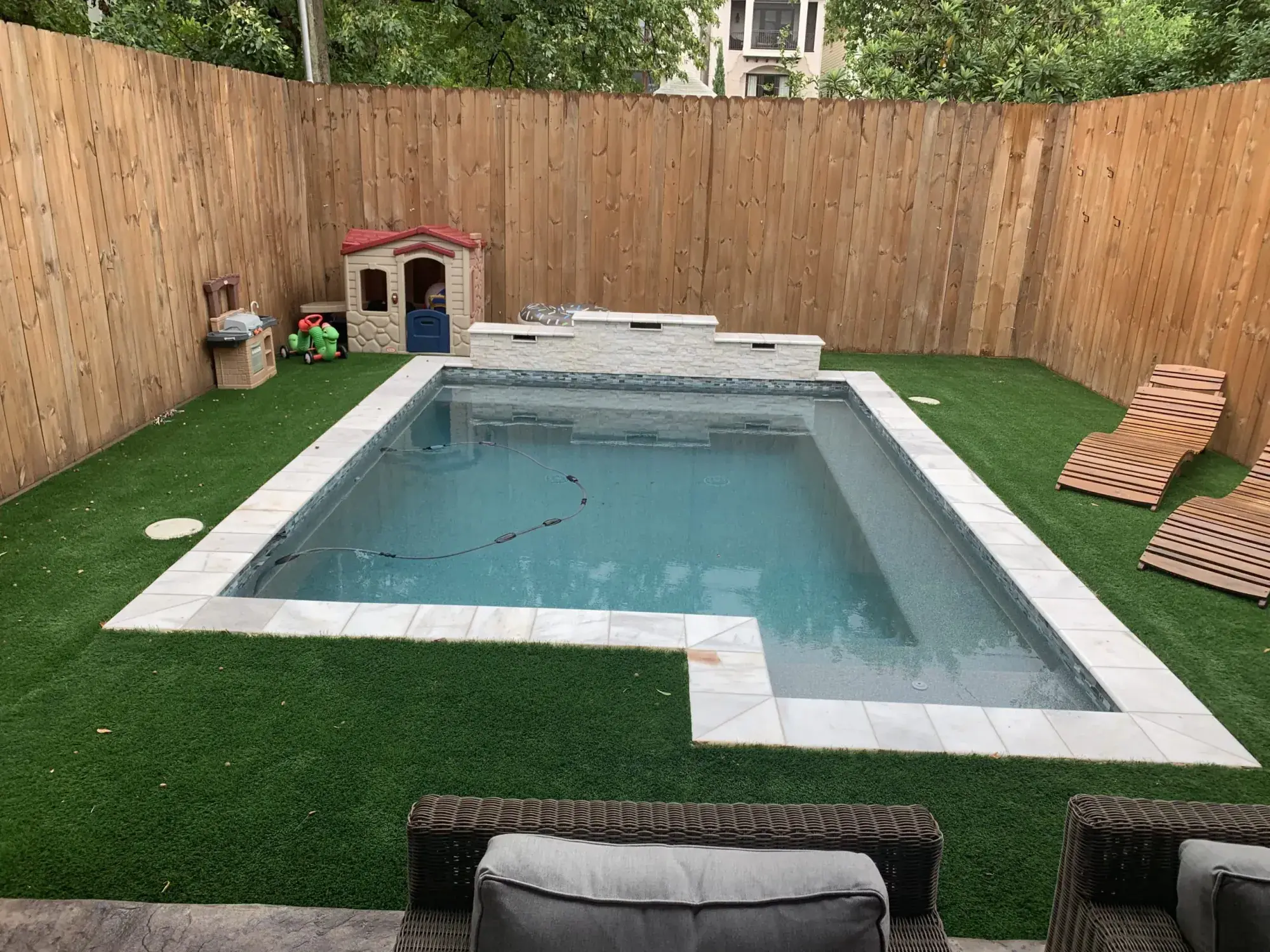
Some of my favorite projects in recent years have been the smallest ones. The Heights, Montrose, West U, EaDo — neighborhoods where the backyard is a courtyard and the old answer was "sorry, no room for a pool." The new answer is the plunge pool, and it's the best thing to happen to inner-loop backyards in my career. But it comes with two misconceptions I find myself correcting weekly, so let's do those first.
Misconception one: "it's just a big hot tub"
A plunge pool is a real gunite pool — same shell, same finish options, same tile and coping, same equipment — built at a smaller footprint: typically 8–12 feet by 12–20 feet, four to five feet deep. It's engineered and finished exactly like the 40-footer we'd build in Katy, with a StoneScapes pebble interior and proper equipment. What it isn't is a fiberglass tub dropped in a hole. The difference shows in year fifteen.
Misconception two: "it must cost half as much"
Honest numbers: a custom plunge pool in Houston generally runs $45,000–$70,000 — meaningfully less than a full-size custom build, but nowhere near half, and it's better you hear that from me than discover it in bids. Here's why: the expensive parts of any pool are mobilization, excavation and access, the gunite shell, the equipment pad, and permitting — and none of those shrink proportionally with the water. A plunge pool is 100% of the engineering at 40% of the gallons.
What you save shows up later: fewer chemicals, less electricity, faster cleaning, cheap heating. A plunge pool costs noticeably less to own, which for a lot of owners matters more than the build price.
What plunge pools are genuinely great at
Cooling off — the actual Houston use case. Let's be honest about how Houston families use pools: it's 98 degrees, you want to be in water, not swimming laps. A plunge pool nails the way pools get used here.
Twelve-month usefulness. The small volume is a superpower: add a heat/chill unit and the pool warms to spa temperatures fast and affordably in January, and — the part people don't expect — chills below tap temperature in August, when every full-size pool in Houston turns to bathwater. A plunge pool is arguably more usable across the year than a big pool.
Design density. With a small footprint you can afford the good stuff — glass tile, a sheer descent on a raised wall, integrated bench seating with hydrotherapy jets, turf and travertine around it. Small pools built well look expensive, because per square foot they are.
Fitting where nothing else fits. Tight access is often the real constraint on inner-loop lots — the excavator has to get to the backyard somehow. Plunge-scale projects can work with access that would kill a full-size build. That's a site-visit question, and it's exactly what our new construction consultations sort out.
Who should skip it
Fair is fair: if you have lap swimmers, water-volleyball teenagers, or dreams of a diving well, a plunge pool will frustrate you — it's a soaking and lounging pool, full stop. And if your lot can comfortably take a mid-size pool, the cost difference to get real swimming space is often worth stretching for. The plunge pool is the right answer to a space problem or a lifestyle preference, not a bargain hunt.
If you've got a small yard and you've been assuming a pool was off the table, it probably isn't. Call 713.462.0762 or request a free quote — we'll look at your access, your space, and your budget and tell you what actually fits.
Frequently asked questions
A custom gunite plunge pool typically runs $45,000–$70,000 depending on size, finish, and features — less than a full-size custom pool but not half price, because the expensive parts (excavation, gunite shell, equipment pad, permits) don't shrink much with the pool.
Typically 8–12 feet wide and 12–20 feet long, four to five feet deep. Big enough to cool off, wade, float, and sit a family in — designed for lounging rather than swimming laps.
Yes, and you should — it's the plunge pool's superpower. The small water volume heats fast and affordably, so a heat/chill unit turns it into a spa in January and a cold plunge in August. It makes the pool a twelve-month feature instead of a summer one.
Ready to talk about your pool?
Tell us what you need and we'll get back to you fast — usually the same day.
Keep reading
- How Much Does Pool Cleaning Cost in Houston? Here Are Our Actual Prices
Most pool companies make you call for a price. Here's exactly what weekly pool cleaning costs in Houston — our real plans, our real rates, and what moves the number up or down.
- What Pool Resurfacing Really Costs in Houston (From a Guy Who Writes the Quotes)
Real numbers, what actually drives them up or down, and how to read a resurfacing quote so you never get surprised. The pricing conversation I have at kitchen tables, written down.
- Pool Deck Resurfacing in Houston: Your Options, Honest Costs, and What Holds Up
Cracked, spalling, or just dated — the deck ages faster than the pool in Houston. Here's the full options ladder from reseal to travertine, with real per-square-foot numbers and what our clay soil does to each choice.